








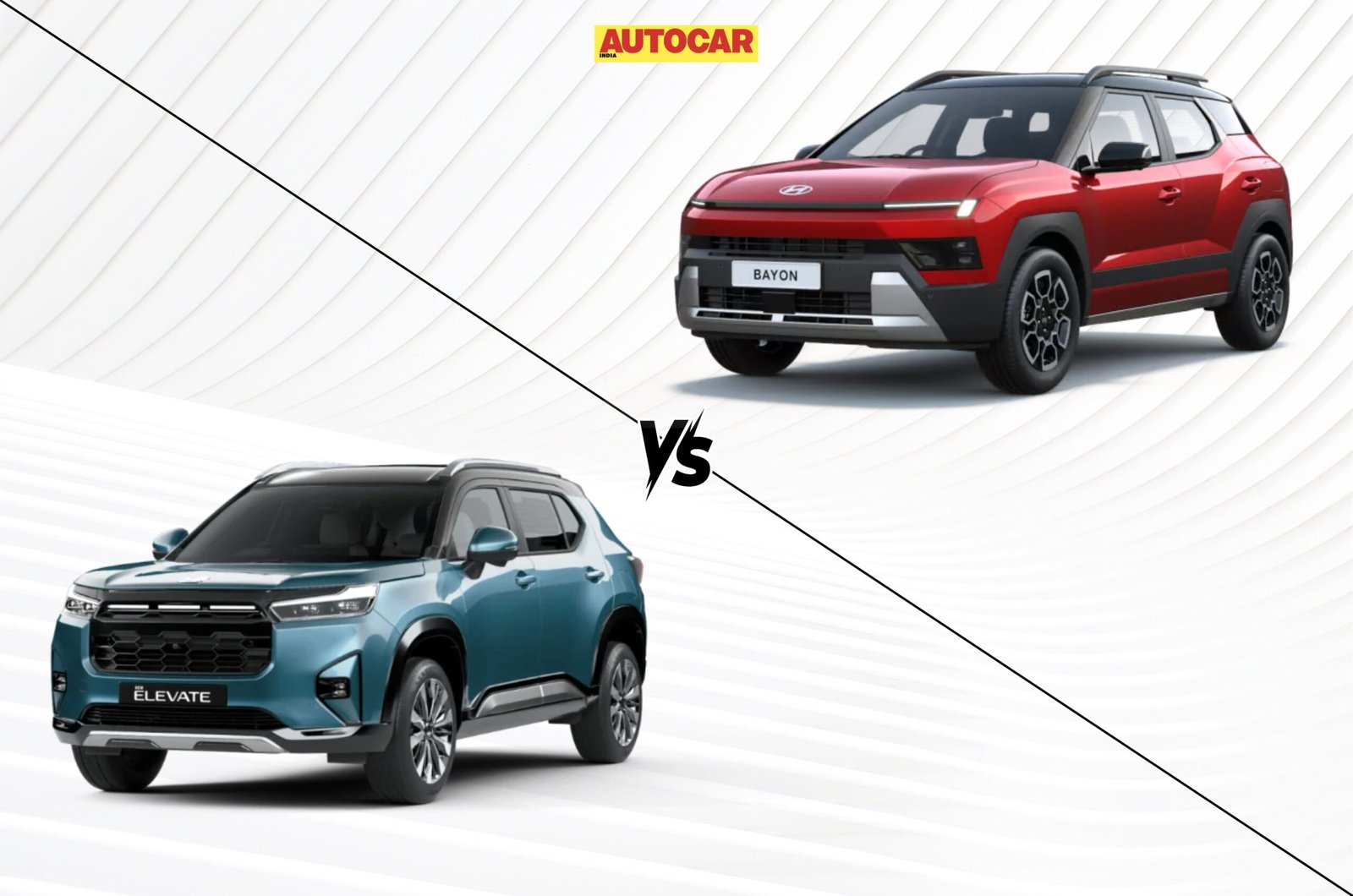
The Hyundai Bayon and Honda Elevate are both midsize SUVs that are only offered with naturally aspirated engines. The Bayon sits atop Hyundai’s Global K enhanced platform and joins the Korean brand’s line-up of SUVs, finding itself below the Creta. Meanwhile, the Elevate was facelifted for 2026 and added a new top-end variant. Today, we’ll be pitting the Elevate ZX+ against its equivalent top-end Bayon, the HX10.
Explore full specs, features and a price breakdown in our Bayon and Elevate comparison.
Hyundai Bayon HX10 vs Honda Elevate ZX+: Dimensions
The Elevate is the bigger SUV but it’s the Bayon that claims a larger boot
|
Hyundai Bayon HX10 vs Honda Elevate ZX+: Dimensions |
||
|
|
Hyundai Bayon HX10 |
Honda Elevate ZX+ |
|
Length (mm) |
4,245 |
4,312 |
|
Width (mm) |
1,810 |
1,790 |
|
Height (mm) |
1,605 |
1,650 |
|
Wheelbase (mm) |
2,600 |
2,650 |
|
Ground clearance (mm) |
205 |
220 |
|
Boot space (litres) |
505 |
458 |
|
Fuel tank (litres) |
43 |
40 |
|
Wheel size (inches) |
17 |
17 |
The Honda Elevate is clearly the larger of the two SUVs here. It’s 67mm longer and 45mm taller than the Hyundai Bayon. The Elevate also has a 50mm longer wheelbase and 15mm more ground clearance. On the other hand, the Bayon is 20mm wider.
When it comes to boot space, it’s the Bayon that offers a claimed capacity of 505 litres. This is 47 litres more than what the Elevate’s boot can hold, whose claimed capacity is 458 litres. The Bayon also gets a slightly bigger fuel tank, holding 3 litres more petrol. In their top-spec trims, both midsize SUVs ride on 17-inch alloy wheels with 215/55 tyres.
Hyundai Bayon HX10 vs Honda Elevate ZX+: Powertrain
The Elevate is punchier while the Bayon offers drive modes and auto stop-start
|
Hyundai Bayon HX10 vs Honda Elevate ZX+: Powertrain |
||
|
|
Hyundai Bayon HX10 |
Honda Elevate ZX+ |
|
Engine |
1.5-litre naturally aspirated petrol |
1.5-litre naturally aspirated petrol |
|
Displacement (cc) |
1,497 |
1,498 |
|
Power (hp) |
115 |
121 |
|
Torque (Nm) |
144 |
145 |
|
Gearbox |
6-speed MT/CVT |
6-speed MT/CVT |
|
Claimed mileage (kpl) |
*TBD/18.6 |
15.31/16.61 |
|
Paddle shifters |
Yes (CVT only) |
Yes (CVT only) |
|
Drive modes |
Yes (CVT only) |
No |
|
Auto-engine stop-start |
Yes |
No |
*Bayon manual mileage yet to be disclosed.
Both SUVs are equipped with similar-sized naturally aspirated four-cylinder petrol engines. Moreover, they are also offered with the same types of gearboxes: either a 6-speed manual transmission (MT) or a continuously variable transmission (CVT). The Elevate’s engine offers slightly more punch, putting out 6hp and 1Nm more than the Bayon’s unit. While the CVT versions of both get paddle shifters, the Elevate’s setup features a 7-step manual mode.
The Bayon fights back with a ‘Dash Boost’ mode, which Hyundai claims temporarily provides more power for overtaking. The Bayon also comes with automatic engine stop-start and drive modes, features that the Elevate misses out on. While Hyundai is yet to publish the Bayon MT’s mileage figure, its CVT avatar is more fuel efficient than the equivalent Elevate, with a claimed mileage of 18.6kpl compared to the Elevate CVT’s 16.61kpl.
Hyundai Bayon HX10 vs Honda Elevate ZX+: Exterior features
Bayon offers puddle lamps while the Elevate gets fog lamps and connected LEDs
|
Hyundai Bayon HX10 vs Honda Elevate ZX+: Exterior features |
||
|
|
Hyundai Bayon HX10 |
Honda Elevate ZX+ |
|
LED projector headlamps |
Auto |
Auto |
|
LED DRLs |
Yes |
Yes |
|
LED fog lamps |
No |
Yes |
|
LED tail lamps |
Yes |
Yes (connected) |
|
Puddle lamps |
Yes |
No |
|
Power-folding ORVMs |
Yes |
Yes |
|
Diamond-cut alloys |
Yes |
Yes (dual-tone) |
|
Roof rails |
Yes |
Yes |
|
Rear wiper & washer |
Yes |
Yes |
|
Rear defogger |
Yes |
Yes |
|
Rear spoiler |
Yes |
Yes |
|
Dual-tone paint |
Optional |
Optional |
The Hyundai Bayon gets dual LED projector headlamps and puddle lamps, both of which aren’t available with the Honda Elevate. The Elevate, on the other hand, offers connected LED elements, front fog lamps and two-tone alloy wheels. Both SUVs get automatic function for the headlamps, a rear wiper & washer, and power-folding outside rearview mirrors (ORVMs). Dual-tone paint options are also available on both.
Hyundai Bayon HX10 vs Honda Elevate ZX+: Interior features
Bayon’s cabin wins on outright equipment but the Elevate gets a few things right too
|
Hyundai Bayon HX10 vs Honda Elevate ZX+: Interior features |
||
|
|
Hyundai Bayon HX10 |
Honda Elevate ZX+ |
|
Touchscreen |
12.3-inch |
10.25-inch |
|
Digital driver’s display |
12.3-inch |
7-inch with analogue dials |
|
Wireless Apple CarPlay & Android Auto |
Yes |
Yes |
|
Connected car tech |
Yes |
Yes |
|
OTA updates |
Yes |
No |
|
AI voice assistant |
Yes |
No |
|
Audio system |
8-speaker Bose |
8-speaker |
|
Sunroof |
Panoramic |
Single-pane |
|
Seat upholstery |
Leatherette |
Leatherette |
|
Front ventilated seats |
Yes |
Yes |
|
Rear ventilated seats |
No |
Yes |
|
Powered driver’s seat |
8-way |
8-way |
|
Powered co-driver’s seat |
No |
4-way |
|
Rear-seat recline |
2-step |
No |
|
Split rear seats |
Yes |
Yes |
|
Rear armrest with cupholders |
Yes |
Yes |
|
Auto climate control |
Single zone |
Single zone |
|
Rear AC vents |
Yes |
Yes |
|
Wireless charger |
Yes |
Yes |
|
USB ports |
3 |
4 |
|
Ambient lighting |
Yes |
Yes |
|
Auto-dimming IRVM |
Yes |
Yes |
|
Keyless entry & go |
Yes |
Yes |
Between the two, the Hyundai Bayon offers more digital real estate and also some future-ready tech. The former comes in the form of dual 12.3-inch curved displays, while the latter comprises a generative AI voice assistant by Perplexity and compatibility for OTA (over-the-air) updates. In comparison, the Honda Elevate’s top-spec variant features a smaller 10.25-inch touchscreen and a part-digital instrument cluster consisting of a 7-inch display and analogue dials.
Other highlights on the top-spec Bayon include an 8-speaker Bose audio system with a subwoofer, a panoramic sunroof and a 2-step reclining function for the rear seats. Where the Elevate gains some ground is with its ventilated function for the rear seats, a powered co-driver’s seat and additional USB outlets. Both midsize SUVs offer niceties like leatherette upholstery, ventilated front seats, automatic AC, wireless charging and wireless smartphone connectivity.
Hyundai Bayon HX10 vs Honda Elevate ZX+: Safety features
Both are well equipped but the Bayon has the more comprehensive ADAS suite
|
Hyundai Bayon HX10 vs Honda Elevate ZX+: Safety features |
||
|
|
Hyundai Bayon HX10 |
Honda Elevate ZX+ |
|
Airbags |
6 |
6 |
|
Electronic stability control |
Yes |
Yes |
|
Hill-start assist |
Yes |
Yes |
|
Front disc brakes |
Yes |
Yes |
|
Rear disc brakes |
Yes |
Yes (CVT only) |
|
Electronic parking brake with auto-hold |
Yes |
Yes (CVT only) |
|
Tyre-pressure monitoring system |
Yes |
No |
|
360-degree camera |
Yes |
Yes |
|
Blind-spot camera |
Yes |
Yes |
|
Parking sensors |
Front & rear |
Front & rear |
|
Dashcam |
Yes |
No |
|
Adaptive cruise control |
Yes (CVT only) |
Yes |
|
Nav-based cruise control |
Yes (CVT only) |
No |
|
Highway Driving Assist |
Yes (CVT only) |
No |
|
Lane-keep assist |
Yes |
Yes |
|
Auto high beam |
Yes |
Yes |
|
Blind-spot warning |
Yes |
No |
|
Rear cross-traffic alert |
Yes |
No |
|
Safe-exit warning |
Yes |
No |
The top-spec trims of the Hyundai Bayon and Honda Elevate get 6 airbags, electronic stability control, all-round disc brakes, electronic parking brake (EPB) with auto-hold, 360-degree cameras and more. That said, the Elevate gets the rear discs and EPB only with the CVT option. Both also get Level-2 ADAS (advanced driver assistance systems) features such as adaptive cruise control, lane-keeping assist and automatic high-beam.
However, the Bayon also gets rear cross-traffic alert and safe-exit warning. Its adaptive cruise control system adds navigation-based assistance that can modulate speeds for upcoming turns on the road. Another safety-related addition to the Bayon’s equipment list is a dashcam. Where the Elevate gets Honda’s LaneWatch camera, the Bayon comes with a blind-view monitor. The Hyundai SUV gets a factory-fit TPMS, which the Honda does not.
Hyundai Bayon HX10 vs Honda Elevate ZX+: Price
|
Hyundai Bayon HX10 vs Honda Elevate ZX+: Price (ex-showroom) |
||
|
|
Hyundai Bayon HX10 |
Honda Elevate ZX+ |
|
Price range (Rs, lakh) |
16.65-18.00 |
16.88-18.58 |
The fully loaded Hyundai Bayon manual costs Rs 23,000 less than its equivalent Honda Elevate. The price delta increases to Rs 58,000 if you opt for the top-spec CVT variant of the Elevate. While it gets rear-seat ventilation and is a slightly larger and more spacious car, the Elevate ZX+ isn’t as feature-packed as its higher price tag suggests. The Bayon HX10 is slightly more affordable while offering larger displays, a panoramic sunroof, a Bose audio rig, a bigger boot, a higher claimed fuel efficiency and a more advanced ADAS suite.