









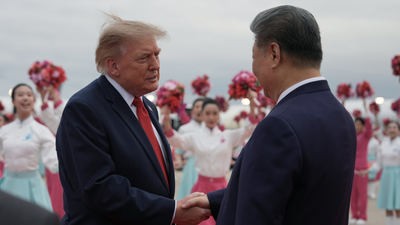
Just miles from the villa where US President Donald Trump met Chinese President Xi Jinping last week for APEC Summit, some of America’s most tightly restricted AI chips are being openly sold in Shenzhen’s bustling electronics market, according to a Washington Post report.The revelation comes amid heightened US scrutiny of Nvidia following reports that its CEO, Jensen Huang, had an extramarital affair with Alice Huang, a company customer who was allegedly a Chinese intelligence asset.The American newspaper found that vendors at the market were offering some of Nvidia’s most advanced chips, including the Blackwell B300, despite US restrictions on their export to China.During a recent visit, one vendor quoted 20 million yuan, or around $3 million, for a server containing eight Blackwell B300 chips after contacting suppliers. Other traders quoted prices ranging from $3 million to $3.4 million for similar servers.The prices have risen sharply in recent weeks amid tighter US export controls. A vendor identified only by his surname, Wu, told The Washington Post that a Blackwell B300 server cost around $2 million two months ago.Nvidia does not publicly disclose prices for its high-end chips.However, an equivalent B300 server costs roughly $500,000 to $600,000 in the US, Kyle Chan, a fellow at the Brookings Institution, told Washington Post.The availability of these chips in Shenzhen highlights the challenges Washington faces in enforcing restrictions aimed at preventing China from accessing advanced American technology and maintaining the US lead in artificial intelligence.Since Nvidia introduced its Blackwell series in 2024, the US has prohibited their shipment to China over national security concerns.These chips generally considered of advanced AI processors that the US restricts from being exported to major powers such as China.However, vendors told The Washington Post that restricted chips continue to reach the Chinese market through supply networks involving Hong Kong and other locations.“If I ever wanted to be a big [Chinese AI developer] and I needed a bunch of Blackwells, I would just go to Huaqiangbei and work out a deal,” Joshua Woodard, founder of Shenzhen-based supply chain consultancy Sparrows, told the newspaper.The market attracts start-ups, independent developers and foreign buyers. One vendor, Jason Cheng, said customers from Russia and Iran had been purchasing Nvidia chips from his stall for the past four or five years.“We don’t care which country a customer comes from, as long as they can pay,” Cheng said.Some traders said the products were kept in warehouses in Shenzhen and nearby Hong Kong and demanded advance deposits before allowing buyers to inspect them.Other Nvidia products, including RTX 5090 and RTX PRO 6000 chips, were openly displayed at the market. A vendor said these were usually sourced through Hong Kong and acknowledged their restricted status.In a statement to Washington Post, Chinese embassy spokesperson Liu Chang said, “China’s position on US chip exports to China is consistent. China opposes the US overstretching the concept of national security and abusing export control measures, which disrupt the stability of global industrial and supply chains.”The report also pointed to public procurement records showing that Chinese research institutes and universities continued to acquire export-restricted Nvidia chips through 2025 and 2026, including as recently as last month.Amid the scandal, Jensen Huang stepped down as Nvidia CEO but returned to the position just days later.