









I’ve been wanting to try 3D printing, people tell me. Which printer should I get?
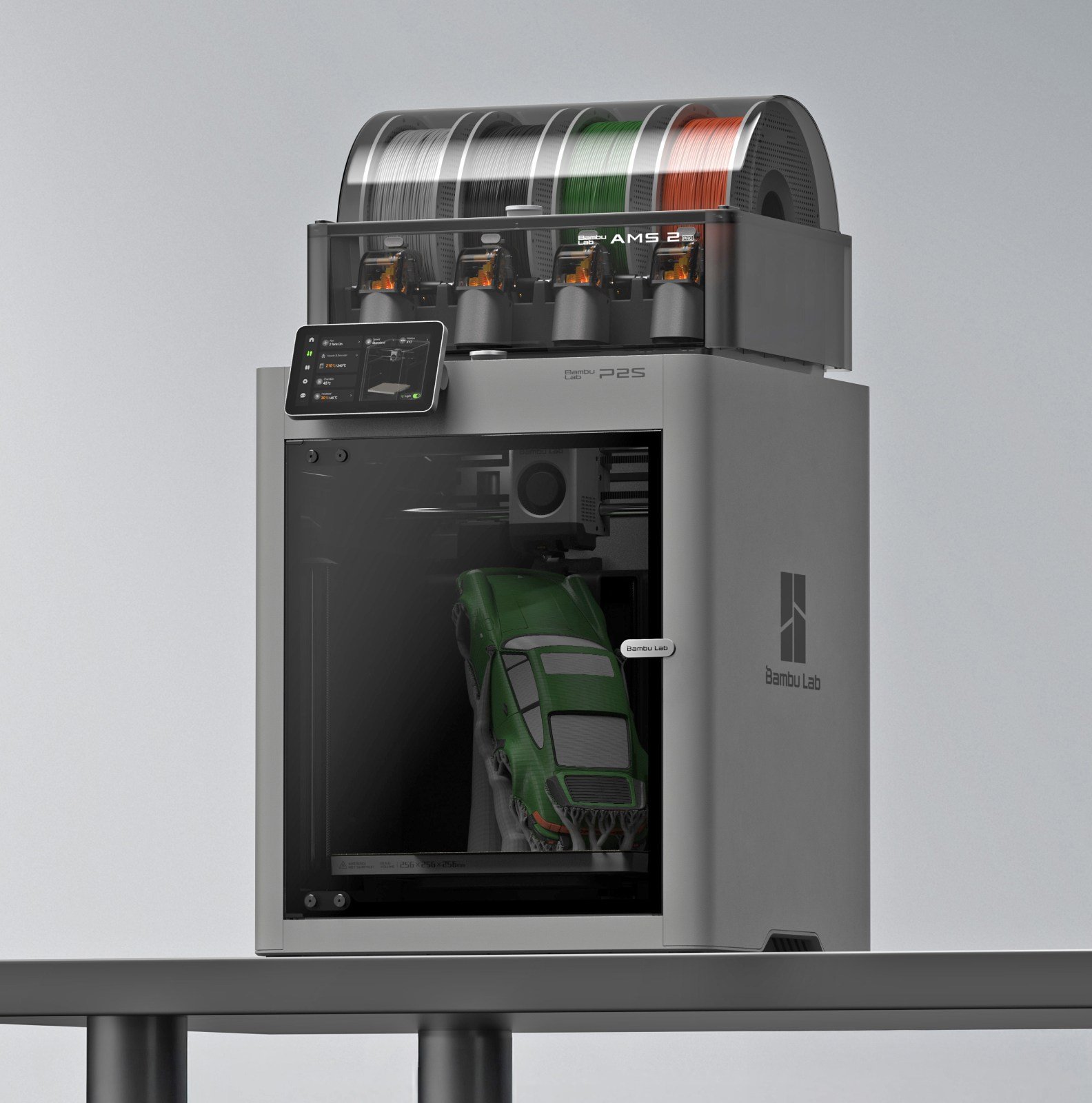
I finally have a fairly easy answer: the Bambu Lab P2S Combo. The auto-loading, fully enclosed touchscreen printer is one of the very few I can recommend. It’s the only one I’d buy for myself. It’s on sale for $649 through December 1st, but I’d vouch for it even at its normal $749 price.
I’ve spent an entire year testing the P2S alongside several competitors, printing 40,000 whistles for ICE whistleblowers along the way. After racking up 6,770 hours of print time across four different printers, I’m sure of my recommendation.

Some people who know 3D printers will argue with me:
- Some will say you shouldn’t support Bambu because it’s profiting at the open-source community’s expense.
- Others will say you shouldn’t spend so much when a $369 Elegoo Centauri Carbon 2 Combo or a $509 Bambu P1S Combo can print just as well.
- Some will say you should save $100 or more by skipping multicolor “Combo” systems.
- Some may even say, “What about all the fancy new tool-changing printers you just wrote about, Sean? Won’t the leaked P3C make the P2S obsolete?”
But for the reasons I’ll explain below, the P2S Combo is my pick despite all of that. It’s durable, reliable, and simple to maintain and clean and forget about, even in ways my trusty Bambu P1P and the similar P1S lacked.
The P2S makes 3D printing easy. When I’m in the mood, I don’t even need to walk over to my printer half the time. I can fire it up from my phone or laptop, using Bambu’s app to send one of millions of ready-made models from the cloud. The automated material system (AMS) automatically loads one of the rolls of filament that I leave in its protected enclosure for months at at time without fear. It automatically calibrates, automatically prints, automatically winds the filament back up when it’s done.

I tell friends that no matter which printer you buy, you should buy a multi-material system “Combo” because manually loading and unloading filament is a chore; it means standing around a printer waiting for it to heat up and feeding plastic into a tube by hand. Automated filament systems can fix that. For me, it’s not about having lots of colors in a single print; it’s about knowing I can print something black, or white, or red, or my kid’s favorite sparkly purple without any further effort — because I loaded those colors weeks ago.
It is true that the $369 Elegoo Centauri Carbon 2 Combo also has automatic four-color filament feeding at a seemingly unbeatable price, and printed whistles and household items just as well as the P2S. I’ve spent 1,271 hours printing with the Centauri Carbon, and 939 hours with a Centauri Carbon 2, and they printed almost flawlessly right out of the box — no need to level a bed, no need to adjust belt tension, the printer calibrates itself.

But like other Bambu rivals, Elegoo doesn’t automatically load its filament from mostly airtight containers. I can’t leave rolls of filament in the printer for weeks or months when I’m not actively using them because they’ll quickly absorb moisture from the air, turn brittle, and jam up the printer’s tubes or nozzle.
Moisture is the primary reason I wouldn’t recommend an inexpensive Bambu A1 Combo to newcomers, either, or a Snapmaker U1, or any other attractive multicolor printer without sealed filament storage. The entire experience of using a 3D printer is friendlier when you don’t have to prep the printer before printing.

Even so, it’s pretty dang tempting to save $280 or more by going with the Elegoo. But over the course of the roughly 1,000 hours I tested the Carbon and Carbon 2 side by side with the Bambu P2S, the Elegoo printers broke down in ways that were more difficult to diagnose.
The original Carbon’s extruder had some feeding issues and I found a lot of black dust inside after taking it apart, seemingly from worn plastic gears. Just this week, my Carbon 2’s stopped working after its nozzle mysteriously crashed into the bed and it refused to auto-level itself (which would normally fix that issue). I had to take the bed apart and still couldn’t find anything wrong.
In the end, yanking and reseating four tiny fragile-and-yet-too-tight connectors inside the bed fixed that problem, but it’s not the kind of solution a consumer should have to do.

Anecdotally, my Bambu printers have led a comparatively charmed life: In 1,692 hours of printing with the P2S, I’ve had to swap out the nozzle twice, clean and relubricate the traversal rods and screws several times, wash the removable magnetic printing surfaces a bunch of times with water and dish soap, and clear several filament jams in the AMS. That’s about it.
P2S nozzle replacements are easier, too. When you jam today’s Elegoo printers, you’re going old-school, either by wrenching off a hot nozzle so you can clean or inexpensively replace it ($25 for eight nozzles) or by fishing out tiny wires and unscrewing two bolts to remove an entire $30 hotend (which includes the elements that heat the plastic) at once. With Bambu’s P2S, you can just yank off a gasket and open one spring clip to swap a whole new toolless hotend ($18) in less than a minute. It does help to have a pair of mini pliers to grab the nozzle, though.

The Elegoo printers also have noisy fans that stay active even when you’re not printing, unlike the Bambu, though the Centauri Carbon 2 does shut them off more quickly than the original. Both Elegoo and Bambu let you remotely monitor your prints from its built-in camera and capture timelapse videos, but Elegoo’s camera and lighting are crap quality by comparison.
If I’m being completely honest, Bambu’s own Bambu P1S Combo, at $509 on sale, is the closest competition for the $649 P2S Combo, and I had a hunch it might be my pick in the end. I upgraded my P1P with most of the P1S upgrades, and it’s been a reliable workhorse: nearly 3,000 hours of 3D printing so far.

But over the past year, I’ve gravitated towards the P2S more and more because of its easy-swap hotends, the built-in touchscreen where I easily manage prints and rolls of filament, and all kinds of little improvements that I find I actually care about:
- It has a built-in guide that helps me put the P2S’s magnetic build plate in the right place every time, saving me from failures I’ve had with the P1P.
- It’ll automatically detect if I forget to put the build plate back, too, which saved me once this past year.
- The nozzle wiper is better at removing ooze that might wind up in your print and the poop chute clogs less.
- You don’t need to leave the door or lid open when printing PLA because it has active ventilation.
- It’s easier to add a second AMS later for four more colors, or just a single fifth roll on an external spindle.
- The stainless steel linear rods are easier to clean.
- I can sweep debris right out of the enclosure because the floor is a smooth ramp.
- The camera’s better, and video from it is far better lit.
- The AMS 2 makes it far easier to clear bits of old brittle filament without taking the unit apart.
Plus, I did have to replace the entire heatbed on my P1P once. I can’t say that nothing will go wrong with the P2S, and you shouldn’t take away that they’re as simple as an inkjet. They will need occasional maintenance, you’ll need to load good-quality filament and probably want to avoid rolls that come on lightweight cardboard (I try to buy Bambu, Sunlu, or Elegoo refills for my reusable plastic Bambu spools), and even then there will be components that wear out.

After 1,600 hours, the AMS 2 that came with my Bambu P2S review unit sometimes complains when trying to unwind or rewind some rolls of filament from some slots, and I suspect it’s because some of the gears are wearing prematurely. Bambu recently announced it’ll replace some of those gears free of charge, but only ones manufactured between May and July 2026, and even then you’ll have to be pretty handy to install them yourself.
I strongly believe people buying their first printer should get something tried and true, fully baked, simple to use, and the P2S is the best yet. But even Bambu is still catering more to DIY enthusiasts who’ll tolerate the occasional hardware defect.
So yes, if you’re asking “Which printer should I get,” I think you’d be pleasantly surprised with a P2S! But I wouldn’t blame you for waiting a few more years.