










Imagine this: It’s the first of the month and you have just received that much-awaited notification: “XYZ salary credited to your bank account”.The sky turns pink, well, for a moment.Enter the monthly budget busters: rent, groceries, phone recharge, utility bills, EMIs, skincare haul and that long-pending friends’ group outing. Before the week ends, you’re already waiting for your next paycheque!But if your shopping list hasn’t changed since last month, why are you paying more for it? The answer is rising prices, and consumers expect the ‘mehengai ki maar’ to continue.According to the RBI’s September 2026 Inflation Expectations Survey, households expect inflation to reach 10% over the next 12 months, up from 9.4% in July.Back in October, India’s retail inflation was already higher than the RBI’s upper limit of 6%, touching 6.09%. Food inflation was even higher, standing at 8.94%.And that’s where the pinch is felt most. You can put off buying a new phone or skip a weekend outing, but milk, vegetables, pulses and cooking oil are hard to do without. As their prices rise, you end up spending more on the same shopping list, leaving less money for other expenses.
Inflation is back above 6%: What’s driving the bills
Inflation was relatively low in the early months of 2026, but things began changing from May as the economic fallout of the West Asia conflict started reflecting more prominently in everyday expenses. Rising global crude oil prices led to multiple hikes in petrol and diesel prices in May, pushing up transportation and production costs.Meanwhile, adverse weather conditions and seasonal supply pressures drove up food prices. Retail inflation rose from 3.48% in April to 3.93% in May and continued climbing over the following months, crossing 5% in September and breaching the RBI’s upper tolerance limit of 6% in October.
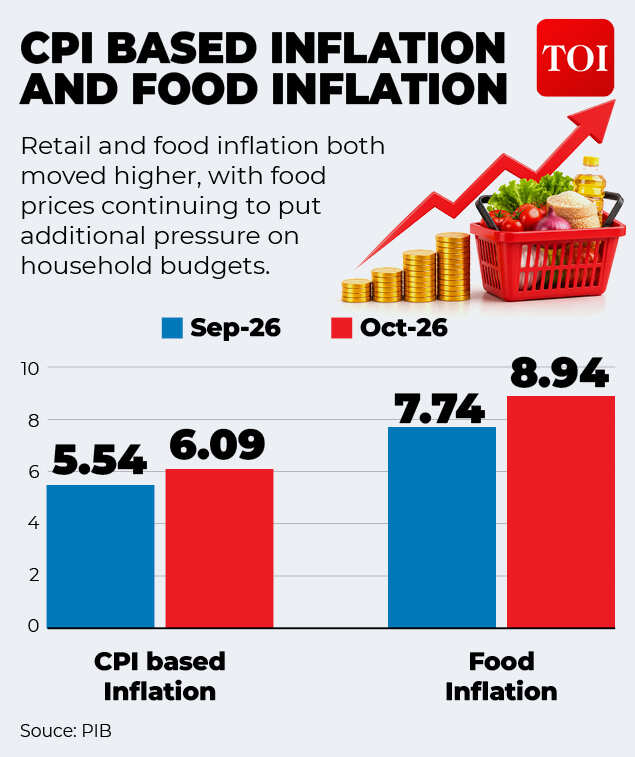
Food inflation and CPI continues to rise
A closer look at household expenses shows where some of the pinch is coming from.Beyond the kitchen, eating out and accommodation costs have risen by 10.06%, while personal care and miscellaneous goods and services have become 10.14% costlier.Transport costs are up 5.84%, with higher fuel prices adding to the cost of travelling and moving goods. So, whether it is your grocery run, dinner out or daily commute, several everyday expenses are taking a bigger bite out of your wallet.So, what’s behind the rising price tags?There isn’t just one culprit. Weather disruptions can affect crop supplies, while global tensions, trade restrictions and supply-chain problems can make commodities more expensive. Add higher fuel and fertiliser costs to the mix, and producing and transporting everyday goods becomes costlier too.Paramdeep Singh, founder of Long Tail Ventures, told TOI that food prices are increasingly shaped by domestic supply conditions and global developments. “Weather disruptions, volatile energy and fertiliser costs, trade restrictions and supply-chain inefficiencies all contribute to price pressures,” he said.
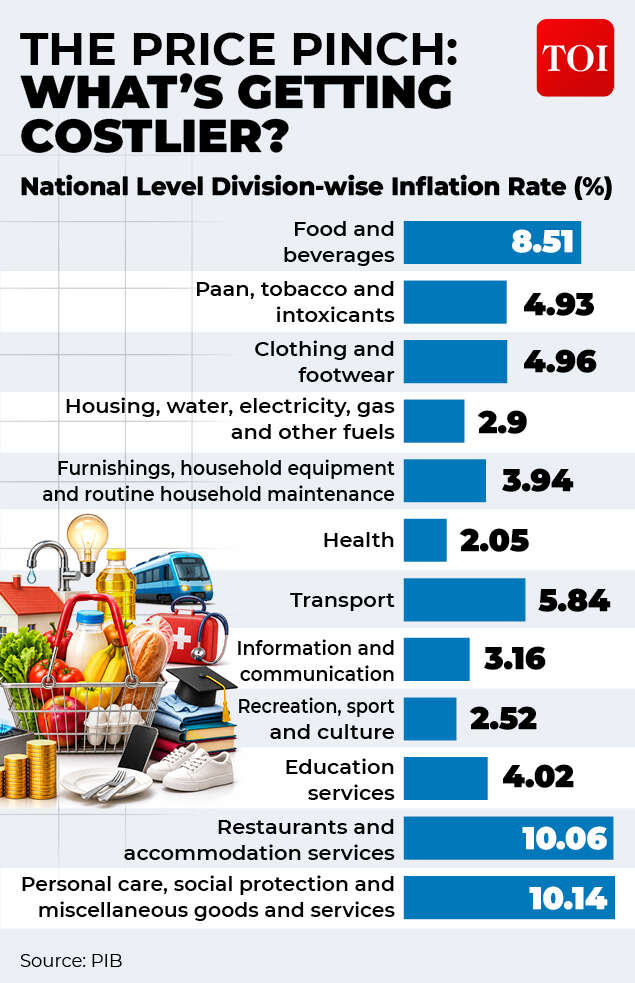
What’s driving up inflation
When monthly expenses rise faster than your income, there is less money left to put away. In simple terms, inflation chips away at your purchasing power, the same salary buys fewer things than it did earlier. And even when inflation cools, it does not mean prices fall. It simply means they are rising at a slower pace.For example, consider a household earning Rs 60,000 a month and spending Rs 50,000. If monthly expenses rise by 6% to Rs 53,000, savings drop from Rs 10,000 to Rs 7,000. That’s a 30% dent in savings, even though expenses have risen by just 6%.Singh says, “The bigger concern is the cumulative erosion of purchasing power. Even when inflation moderates, prices don’t necessarily fall.” That’s why household savings often tell a more complete story than inflation figures alone.
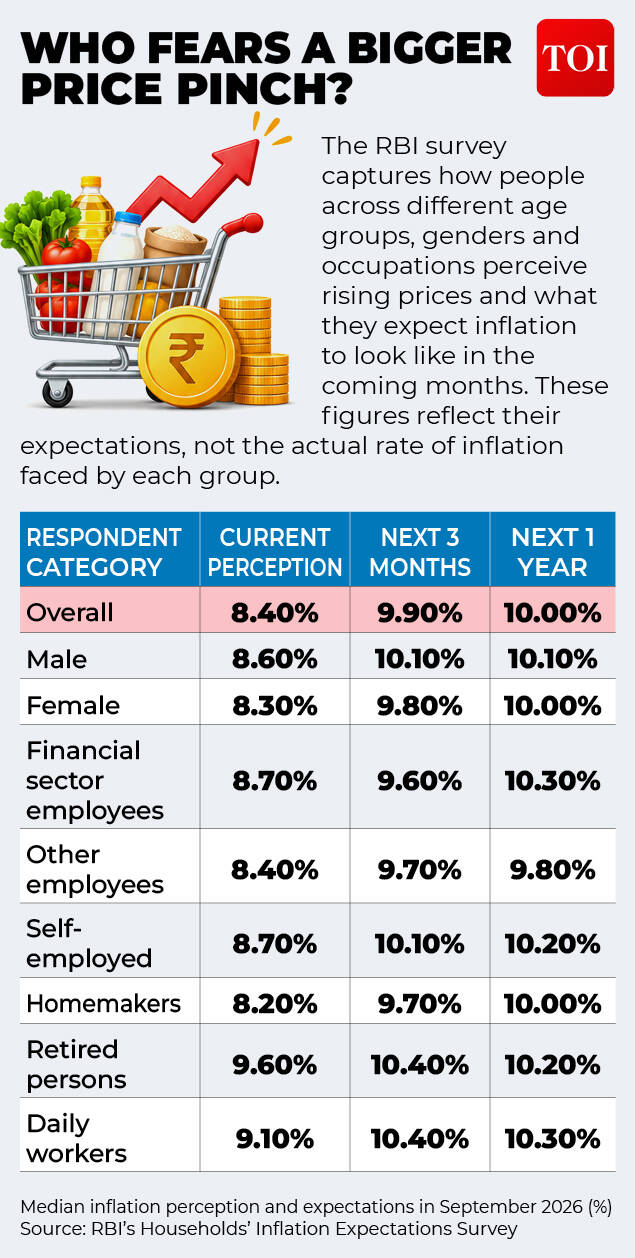
The price pinch: Who expect it the most
Kitchenomics: Why your grocery bill keeps climbing
Food is one of the biggest reasons household budgets are feeling the pinch. It made up 34.78% of the new Consumer Price Index (CPI) basket in October, with food inflation at 8.94%. Even home-cooked meals aren’t escaping inflation, with veg thalis up 12% and non-veg thalis up 9%.Some kitchen staples have seen particularly sharp price jumps. Onion prices surged 116.22% year-on-year, while garlic became 60.74% costlier. Ginger and lemons also saw steep increases of 48.32% and 47.30%, respectively. In the illustrative Gurugram grocery basket, sugar prices rose 21.4% and milk prices increased 7.1% over the year. Edible oil, too, became 7.1% costlier.Shunil Tripathi, SEBI SMART trainer and an NCFE-empanelled resource person, says the biggest concern is that these are everyday purchases that households cannot avoid. “A family may delay buying a phone, but it cannot delay buying dal, oil or milk,” he says.
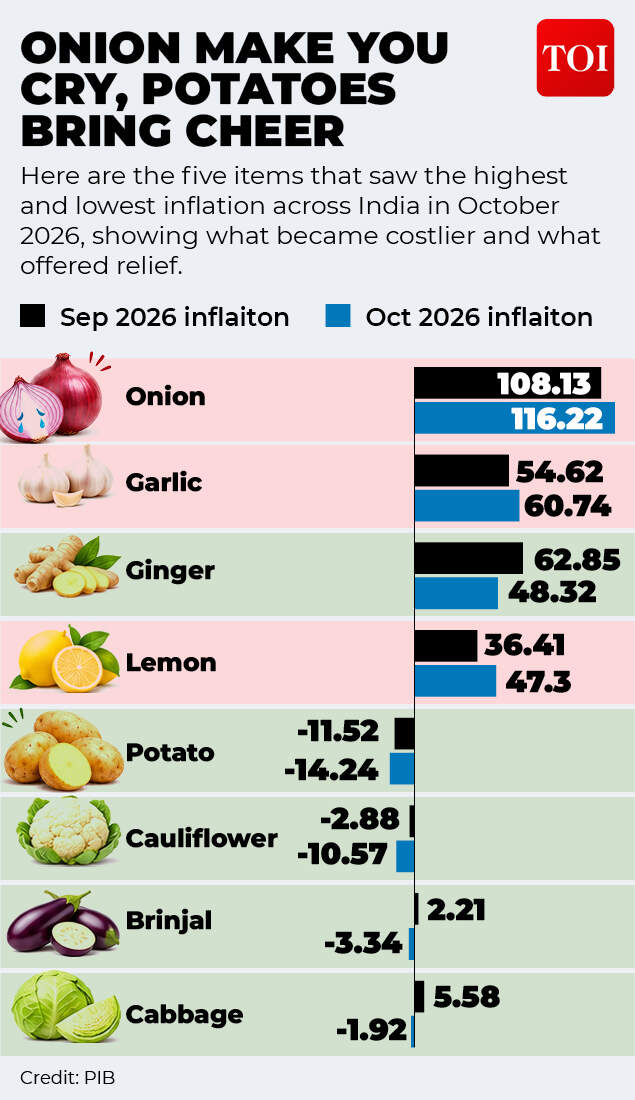
What got cheaper and costlier in your kitchen
He attributes the rise largely to supply-side pressures, particularly the conflict in West Asia and higher petroleum prices. Since fuel is used across industries, any increase in its cost can push up transportation expenses and, in turn, the prices of everyday goods — from vegetables to packaged food.Tripathi shared an example of a grocery basket based on local market prices in Gurugram. Last year, a household could buy the listed items for Rs 1,000. This year, the same basket costs Rs 1,050, even though the family has reduced its biscuit purchase from two packets to one.Had the family bought the same quantities as last year, the bill would have been around Rs 1,071, a 7.1% increase. So, it is paying more but taking home less.
Then vs Now: Same Rs 1,000, smaller grocery haul
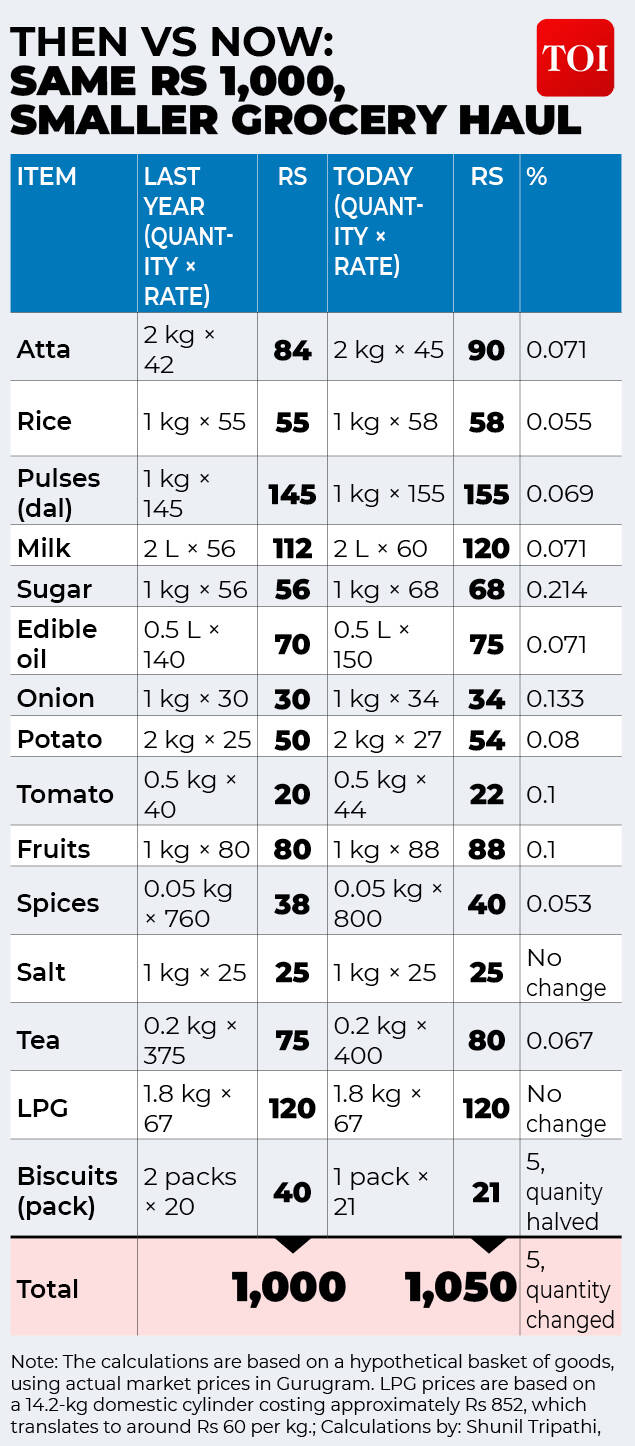
What Rs 1,000 get you
Rural India or urban India: Who is feeling the bigger pinch?
The inflation burden is not evenly distributed across the country. Rural households are facing higher price pressures than their urban counterparts.MoSPI data show that rural inflation climbed to 6.63% in October, compared with 5.41% in urban areas. Food inflation was also higher in rural India at 9.09%, against 8.68% in urban India.The difference matters because food purchases form a regular and unavoidable part of household spending. Higher prices can therefore put pressure on rural budgets even when the overall national inflation number appears relatively moderate.There are also considerable differences across states. Among states, Tamil Nadu recorded the highest combined retail inflation at 7.29% in October. Telangana followed at 7.26%, Andhra Pradesh at 7.25%, Madhya Pradesh at 7.19% and Odisha at 7.17%.Puducherry, a Union Territory, recorded an even higher rate of 7.96%. At the other end, Delhi’s combined inflation stood at 3.80%.These differences show why the experience of inflation can vary depending on where a household lives. The national figure is an average, but the actual price pressure depends on the items people buy and the local markets they depend on.
Are salaries keeping up with rising prices?
As everyday expenses continue to rise, a salary hike can feel like a welcome relief, offering some cushion against bigger bills. But once the monthly expenses are paid, the extra money may not leave as much in your pocket as you had expected.According to Aon’s salary increase survey, India Inc was expected to offer average salary hikes of 9.1% in 2026, compared with 8.9% in 2025. On paper, that may look like a decent cushion against rising prices. But does it really stretch far enough?For starters, these are only averages, and not everyone gets the same pay rise. The real impact also depends on where a household spends most of its money. Grant Thornton Bharat’s India’s Financial Resilience Report 2026 found that 62% of respondents believe their income growth will not be enough to keep pace with future inflation. Among those aged 25-34, the share was even higher at 70%.Tripathi says incomes have broadly held up over the past year, although the picture varies across employees. Government employees received dearness allowance revisions linked to inflation, while private-sector salary hikes depended on performance and individual outcomes. However, when household budgets get tighter, families often cut back on discretionary spending to protect essentials. As he puts it, “Essentials were protected, and ‘wants’ were cut.”
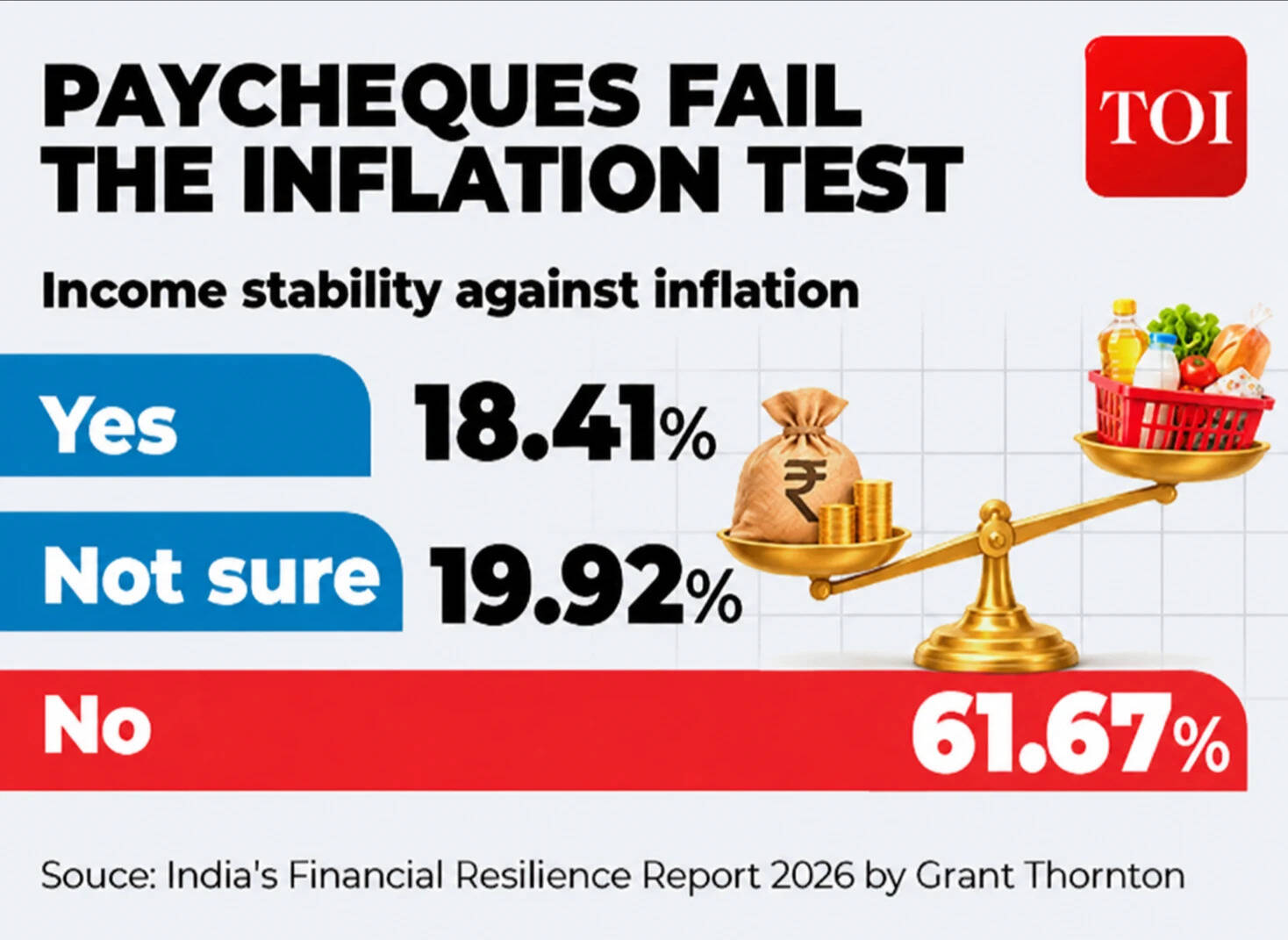
Is your salary hike enough to beat inflation
So, will a salary hike really make you richer? Not necessarily. What matters is how much you can retain after meeting your monthly expenses. For instance, even a 5% reduction in a household’s monthly budget of Rs 50,000 can free up Rs 2,500 a month, or Rs 30,000 annually.Adhil Shetty, CEO of BankBazaar, says households should focus on protecting their cash flow without compromising long-term financial security. “When prices rise faster than income, the first thing that tends to help is building a buffer, roughly a few months of expenses kept aside for emergencies,” he said.He also recommends maintaining an emergency fund covering 3-6 months of essential expenses, prioritising repayment of high-interest debt and reviewing regular spending to identify costs that may have quietly crept up.Ultimately, it is not just about how much extra money lands in your payslip, but how much is left after groceries, bills and other everyday needs. The biggest risk is quietly sacrificing tomorrow’s savings to maintain yesterday’s lifestyle.
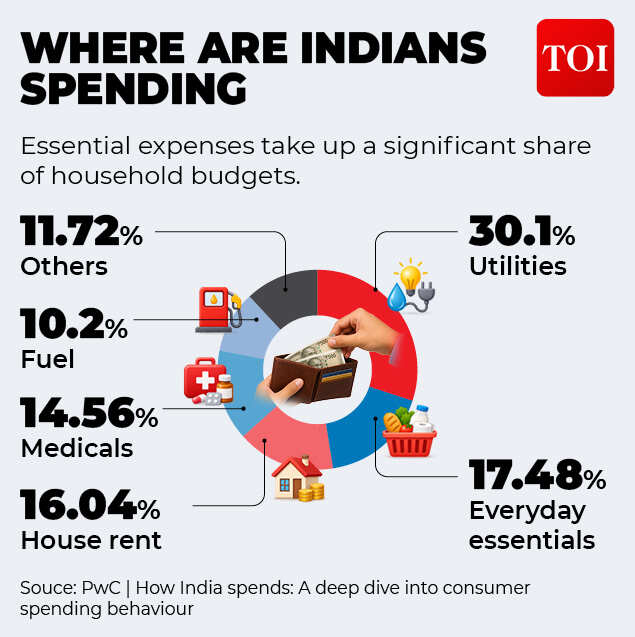
Where does your paycheque go
Breather or burden: Will prices finally cool down?
Will your grocery bills finally give you some breathing room, or is more price trouble waiting around the corner? The answer will depend on food supplies, farm output and global commodity prices over the next few months.Fresh winter crop arrivals could help bring down prices of some food items. However, global fuel prices and transportation costs could continue to keep everyday goods expensive.Shetty says stable global commodity prices and better agricultural output could help inflation cool gradually. Tripathi, meanwhile, believes the current price pressure is largely supply-driven. He points out that raising interest rates cannot directly bring down crude oil prices or freight charges.“Higher interest rates can cool demand, but they cannot lower the cost of crude oil or reduce freight charges,” Tripathi says. In his view, cheaper fuel and smoother supplies are key to easing the pressure.
Relief on two fronts
Bringing down the cost of everyday essentials and leaving households with more money to spend will both be important.In the short term, better food supplies, improved stock management and targeted support for vulnerable households can help ease the burden. Over the longer term, investments in cold storage, farm-to-market transport and agricultural productivity can help prevent sudden price spikes.Singh says relief needs to address both essential costs and household incomes. “Targeted food supply interventions, better inventory management and focused support for vulnerable households can ease pressure,” he says.While targeted support can reach households within weeks, these structural improvements will take longer to deliver results.Ultimately, real relief from inflation is not just about a lower number on paper. It means being able to buy everyday essentials, pay the bills and still have enough left to save, without constantly having to reshuffle the monthly budget.