











Firecrackers bursting on Diwali night led to a sharp rise in pollution in Mumbai. Nine of the city’s 25 air quality monitoring stations recorded poor air on Monday morning. Actor Bhumi Pednekar has now voiced concern over the worsening air after the celebrations.
Bhumi Pednekar’s posts on Instagram
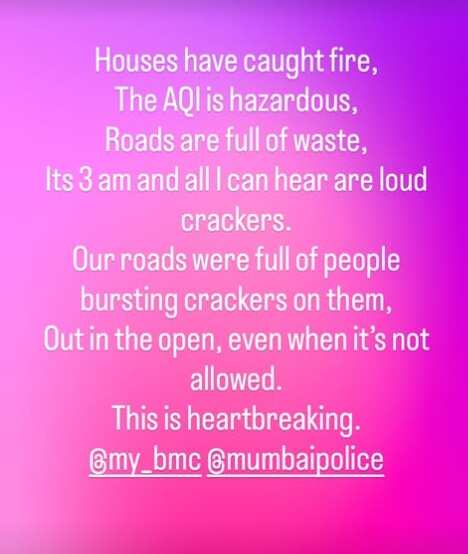
Bhumi Pednekar shared on Instagram Stories: “Houses have caught fire, the AQI is hazardous, roads are full of waste, it’s 3 am, and all I can hear are loud crackers. Our roads were full of people bursting crackers on them out in the open, even when it’s not allowed. This is heartbreaking. @my bmc ®mumbaipolice.”
On Monday morning, she posted another message: “Diwali is a festival of light, love, family and new beginnings. But every year, along with the celebrations, comes a familiar aftermath: polluted air, firecracker waste, noise and frightened animals. Firecrackers release fine particulate matter and other pollutants that add to an already challenging air-quality situation. And the impact isn’t experienced equally. Children, older people, those with respiratory conditions and animals are particularly vulnerable. This year, let’s make a choice that allows everyone, including the ones who cannot speak for themselves, to enjoy the festival.”
Overall AQI stays in the moderate range
Mumbai’s overall Air Quality Index (AQI) stood at 171 on Monday morning, which falls in the moderate category. According to the Central Pollution Control Board (CPCB), an AQI of 0-50 is good, 51-100 is satisfactory, 101-200 is moderate, 201-300 is poor, 301-400 is very poor and 401-500 is severe.Besides the nine stations with poor air, 12 were in the moderate category and three were satisfactory. Only Borivali East recorded good air quality.
Several areas cross 400 overnight
Some pockets of the city saw far higher readings than the citywide average. In Chembur, the AQI rose to 334 and then climbed to 401 overnight before easing to 216 by 7 am.Navy Nagar was among the worst hit. Its AQI was already 359 around 10 pm and stayed close to 400 through the night, peaking at 497 at 2 am. By 7 am, it had dropped to 274.At Shivaji Nagar, the AQI spiked to 444 at 11 pm. Readings were lower before and after that spike, and the AQI stood at 223 at 7 am.